
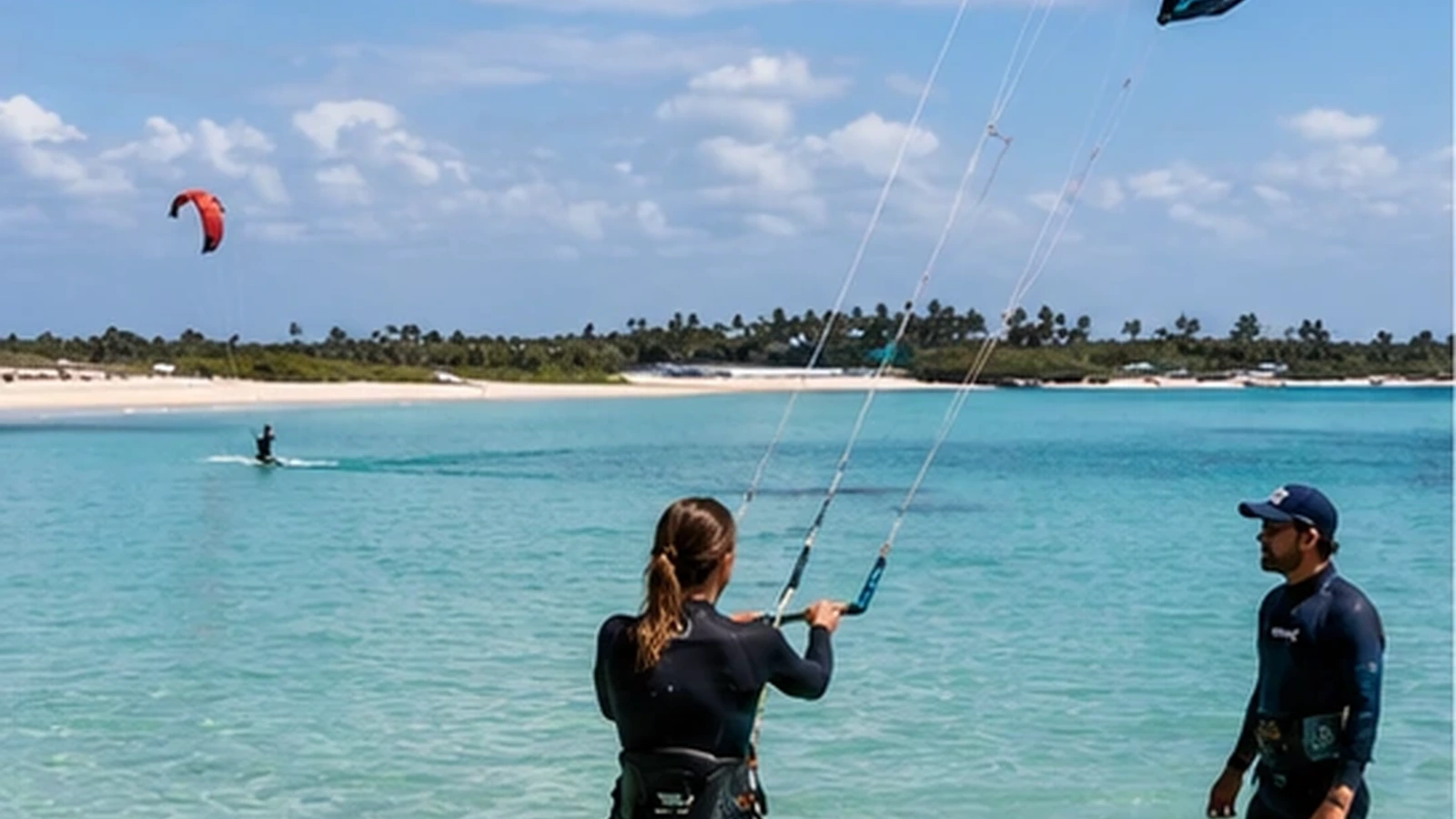
Where you learn decides how fast you learn. The right spot means waist-deep flat water where every crash ends standing up, wind of 15 to 22 knots most days, and a school with a rescue boat. The wrong one means deep water, chop and gusts that add days to your progression. So this ranking puts water first, wind second, and price third, with real 2026 lesson prices throughout.
Prices come from one school per spot, 2026 list prices, scaled to 9 hours. Group means 2 to 4 students per instructor.
The top 10 at a glance
| # | Spot | Water | Season | 9 h of lessons | Flight from US |
|---|---|---|---|---|---|
| 1 | Dakhla, Morocco | Flat lagoon, waist deep | Mar to Oct | $300 group, $600 private | 15 h+ |
| 2 | Lo Stagnone, Sicily | Flat lagoon, knee deep | Apr to Oct | $420 group (2 per instructor) | 12 h |
| 3 | Kalpitiya, Sri Lanka | Flat lagoon, waist deep | May to Sep, Dec to Feb | $500-640 | 20 h+ |
| 4 | El Gouna, Egypt | Flat lagoons, shallow | Apr to Oct | $580 (2 per instructor) | 14 h+ |
| 5 | Cape Hatteras, USA | Sound, waist deep, sandy | May to Oct | $1,800 private | 1-5 h |
| 6 | Langebaan, South Africa | Flat lagoon, shallow, cold | Nov to Mar | $440 (12 h, 2 per instructor) | 20 h+ |
| 7 | Boracay, Philippines | Flat inside reef, shallow | Nov to Apr | $380-520 | 20 h+ |
| 8 | La Ventana, Mexico | Side-shore bay, sandy, deep | Nov to Mar | $900 private | 3-5 h |
| 9 | Cumbuco, Brazil | Beach chop + Cauipe lagoon | Aug to Dec | not verified, ask | 8-10 h |
| 10 | Cabarete, Dominican Rep. | Chop, afternoon wind | Jun to Aug | $700 private | 3-5 h |
The spots, ranked
1. Dakhla, Morocco
Wind 18 to 30 knots on 9 days in 10, March to September. The lagoon is waist deep for hundreds of metres, so every crash ends standing up. Water 19-22 C (66-72 F), bring or rent a 3/2. Cheapest good lessons on this list: group about $30 per hour. Downside: far, and there is nothing else to do.
2. Lo Stagnone, Sicily
Knee to waist deep across most of the lagoon. Thermal wind 12 to 20 knots, April to October, best May to September. Helmet and vest are mandatory. Group lessons about $47 per hour. Many schools, so book early in July and August. Warm water June to September, no wetsuit.
3. Kalpitiya, Sri Lanka
Flat lagoon, 15 to 25 knots May to September, 94% windy days in June. Water 29 C (84 F), no wetsuit. Local schools run 3-hour group lessons per day, 3 days to IKO level 3, about $500-640 total. Cheap rooms. Long flight, then a 3-hour drive from Colombo.
4. El Gouna, Egypt
Shallow flat lagoons, 15 to 25 knots side-onshore, rescue boats and beach staff at every school. April to May and September to October are comfortable; June to August is 35 C (95 F) air. Semi-private 6-hour course $390, 12-hour “zero to hero” $750. Direct flights from Europe, one stop from the US.
5. Cape Hatteras (Outer Banks), USA
Best learning water in the US: Pamlico Sound, waist deep, sandy bottom, warm May to October. Wind is less reliable than the others, so plan a week. Kitty Hawk Kites: 3-hour private $600, semi-private $450 per person. Expensive, but no passport needed, and you can drive.
6. Langebaan, South Africa
Flat lagoon one hour north of Cape Town, 20 to 30 knots November to February, 81-84% windy days. Water 15 C (59 F), full 4/3 plus booties. A 12-hour course is about $440 per person in a pair. Strong wind means big crashes, so it is a fast but rough school.
7. Boracay, Philippines
Bulabog beach, flat and shallow inside the reef, 15 to 25 knots November to March. Water 27 C (81 F). Direct school price: 3 hours per IKO level, 3 levels, about $380. Agency price with hotel pickup about $520. Small lagoon, crowded January to February, and the reef edge is close.
8. La Ventana, Mexico
Steady 15 to 25 knots November to March, sandy beach, warm-ish water (26 C / 79 F in February, shorty in December and January). The water gets deep fast, so early lessons use a boat or beach support. Private only at most schools, about $100 per hour. Fly LAX to La Paz, then a 1-hour drive.
9. Cumbuco, Brazil
Wind every day August to December, water 27 C (81 F). The beachfront is chop with a small shore dump; Cauipe lagoon 5 km away is butter flat and schools drive you there. Many Brazilian and European schools, prices cheaper than the Caribbean, but we could not verify a 2026 list price. Ask before you book.
10. Cabarete, Dominican Republic
Closest warm-water learning spot to the US East Coast. Wind starts after 1 pm, 15 to 25 knots June to August. The bay is choppy; Kite Beach is flatter. Private lessons about $79 per hour, so about $700 for 9 hours. Cheaper than Hatteras, harder water than the lagoons above.
Two rules that matter more than the spot
- Book a school with radios and a rescue boat. Ask by email. If the answer is vague, pick another school.
- 9 hours gets most people riding a few metres. Budget 12 to 15 hours to ride upwind, and plan 5 to 7 days, since wind days are not lesson days. For the full milestone-by-milestone picture, see how long it takes to learn kitesurfing.
Bottom line
Pick standing-depth flat water with steady wind and a rescue boat, then let price break the ties. Dakhla is the complete package if you can stomach the travel, Lo Stagnone and Kalpitiya are close behind, and Cape Hatteras is the answer when you want to drive, not fly. For what the rest of the sport costs once lessons are done, read how much kitesurfing costs, and cross-check seasons against where to kitesurf each month.
Sources: school price lists and booking pages, September 2026. Wind data from our month-by-month spot rankings.